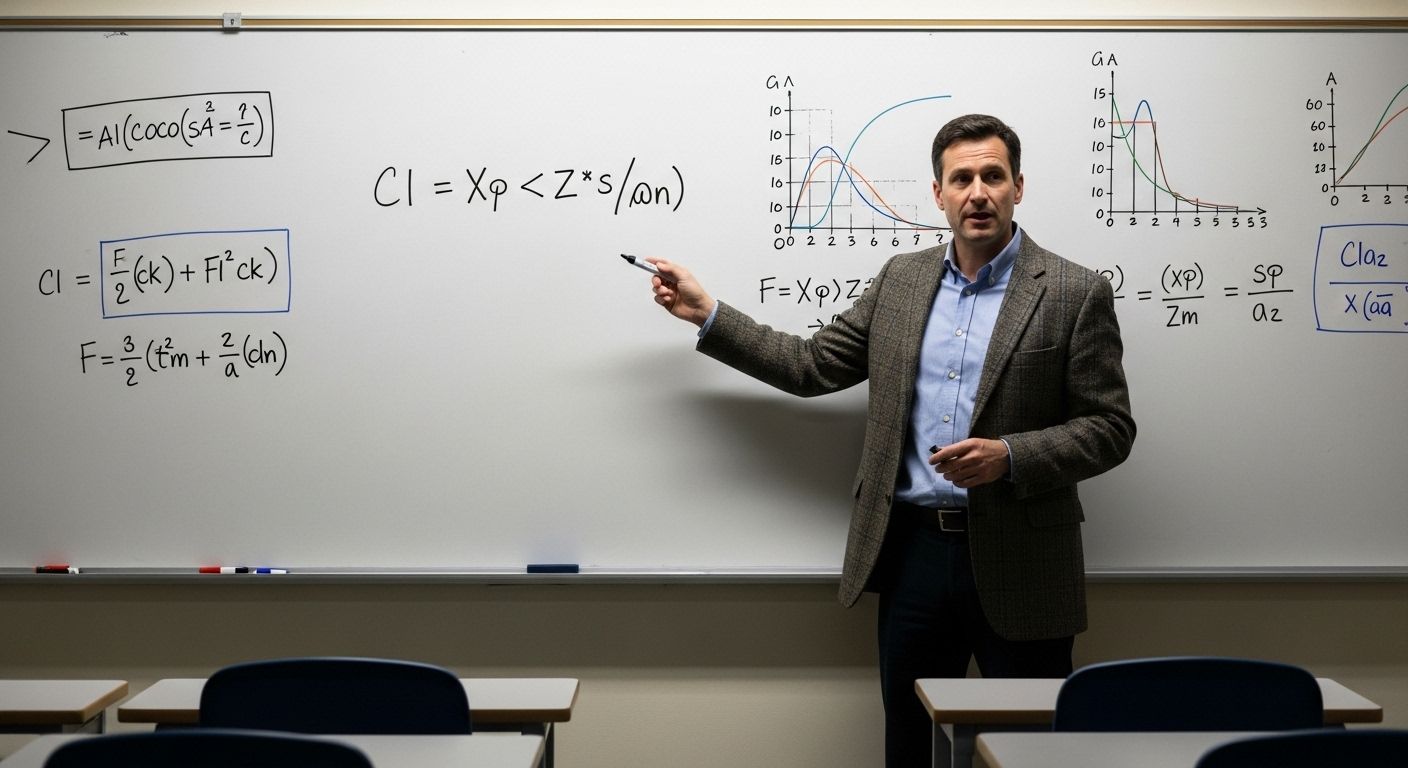
Cumulative Distribution Function of Exponential Distribution

- 1.
What even *is* this “cumulative distribution function of exponential distribution” business?
- 2.
How does the cumulative distribution function of exponential distribution actually work?
- 3.
Why should we care about the cumulative distribution function of exponential distribution in real life?
- 4.
What’s the link between memorylessness and the cumulative distribution function of exponential distribution?
- 5.
How do you plot the cumulative distribution function of exponential distribution?
- 6.
Common mistakes when working with the cumulative distribution function of exponential distribution
- 7.
How does the cumulative distribution function of exponential distribution compare to other distributions?
- 8.
Practical example: calculating failure probability using the cumulative distribution function of exponential distribution
- 9.
Software tools to compute the cumulative distribution function of exponential distribution
- 10.
Where to learn more about the cumulative distribution function of exponential distribution
Table of Contents
cumulative distribution function of exponential distribution
What even *is* this “cumulative distribution function of exponential distribution” business?
Ever sat down with a cuppa, stared at your stats textbook, and thought, “Blimey, why’s everything look like ancient runes?” You’re not alone, mate. The cumulative distribution function of exponential distribution—or CDF, if you fancy saving breath—isn’t as intimidating as it sounds. Honestly, it’s just maths’ way of saying, “Right, what’s the chance that something happens *by now*?” Like waiting for the kettle to boil or your dodgy Wi-Fi to reconnect. The cumulative distribution function of exponential distribution gives us the probability that a random variable X is less than or equal to some value x. And because life’s full of waiting (buses, texts back from your crush, Netflix loading screens), the exponential distribution models those lovely impatient moments where events happen continuously and independently at a constant average rate. So yeah, the cumulative distribution function of exponential distribution is basically your statistical tea leaf reader for timing.
How does the cumulative distribution function of exponential distribution actually work?
Alright, let’s crack on. The exponential distribution is defined by one cheeky little parameter: λ (lambda), which is the rate. Higher λ? Things happen faster. Lower λ? You’ll be twiddling your thumbs longer. Now, the cumulative distribution function of exponential distribution is derived by integrating its probability density function (PDF) from zero up to x. Mathematically, that’s F(x) = 1 − e−λx for x ≥ 0. Fancy, innit? This means if you’ve got a lightbulb with an average lifespan modelled by an exponential distribution, the cumulative distribution function of exponential distribution tells you the odds it’ll have popped before, say, 500 hours. No crystal ball needed—just a bit of calculus and a stiff upper lip.
Why should we care about the cumulative distribution function of exponential distribution in real life?
Because it’s everywhere, guv! From queuing at Tesco to predicting server downtime, the cumulative distribution function of exponential distribution sneaks into daily life like a cat through a flap. Telecoms use it to model call durations. Engineers lean on it for reliability testing—“Will this widget last past Tuesday?” Hospitals apply it to patient arrival rates in A&E. Even your streaming service might use the cumulative distribution function of exponential distribution to guess how long you’ll binge before tapping out. It’s not just academic fluff; it’s the quiet maths behind the chaos of modern existence. And honestly? That’s proper brilliant.
What’s the link between memorylessness and the cumulative distribution function of exponential distribution?
Here’s a quirky bit: the exponential distribution is *memoryless*. Sounds like your nan after her third sherry, but no—it means the probability of an event happening in the next t minutes is the same no matter how long you’ve already waited. Wild, right? This property ties directly into the cumulative distribution function of exponential distribution. Because F(x) = 1 − e−λx, the conditional probability P(X > s + t | X > s) simplifies neatly to P(X > t). Translation? The past doesn’t matter. Your bus isn’t “due” just because it’s late—the cumulative distribution function of exponential distribution treats every moment like a fresh start. Philosophers could write sonnets about that.
How do you plot the cumulative distribution function of exponential distribution?
Grab Python, R, or even Excel—plotting the cumulative distribution function of exponential distribution is easier than brewing Yorkshire tea. Start with x-values from 0 upwards, plug them into F(x) = 1 − e−λx, and watch the curve rise asymptotically toward 1. It’ll look like a lazy S lying on its side, starting flat and curving up gently. The steeper the climb, the higher your λ. Visualising the cumulative distribution function of exponential distribution helps you *see* probabilities instead of just calculating them. And seeing’s believing, especially when your lecturer’s droning on about hazard functions.

Common mistakes when working with the cumulative distribution function of exponential distribution
Oh, where to begin? Folks often mix up the PDF and CDF—remember, PDF gives density (not probability!), while the cumulative distribution function of exponential distribution gives actual cumulative probability. Others forget that x must be ≥ 0; negative time? Not in this universe, love. Some bung in λ when they should use 1/λ (the mean). And let’s not mention the classic typo: writing eλx instead of e−λx—that’ll send your CDF shooting past 1, which is a dead giveaway somethin’s gone pear-shaped. Keep your wits about you, and the cumulative distribution function of exponential distribution won’t bite.
How does the cumulative distribution function of exponential distribution compare to other distributions?
Not all heroes wear capes—some wear bell curves. Unlike the normal distribution, which is symmetric and loves averages, the cumulative distribution function of exponential distribution is skewed right and obsessed with waiting times. Compare it to the Poisson: Poisson counts *how many* events in a fixed interval; exponential measures *how long* between events. They’re two sides of the same coin, really. Meanwhile, the uniform distribution’s CDF is just a straight diagonal line—boring! The cumulative distribution function of exponential distribution has personality: it starts slow, then picks up steam like a London Underground train leaving the station.
Practical example: calculating failure probability using the cumulative distribution function of exponential distribution
Imagine you’ve got a batch of routers, each with a mean time between failures of 10,000 hours. That means λ = 1/10,000 = 0.0001 per hour. What’s the chance one fails within the first year (≈8,760 hours)? Pop it into the cumulative distribution function of exponential distribution: F(8760) = 1 − e−0.0001×8760 ≈ 1 − e−0.876 ≈ 1 − 0.416 ≈ 0.584. So, nearly a 58.4% chance. Ouch. That’s why your IT bloke always looks stressed. Using the cumulative distribution function of exponential distribution turns vague worries into hard numbers—and hard numbers get budgets approved.
Software tools to compute the cumulative distribution function of exponential distribution
You don’t need a slide rule and a pipe to crunch this. In R, it’s pexp(x, rate = λ). In Python (SciPy), it’s scipy.stats.expon.cdf(x, scale=1/λ). Even Excel’s got EXPON.DIST(x, λ, TRUE)—set the last argument to TRUE for cumulative. These tools spit out the cumulative distribution function of exponential distribution faster than you can say “cuppa”. And if you’re visualising, libraries like Matplotlib or ggplot2 make graphs that’d make your stats tutor weep with pride. Tech’s grand when it handles the boring bits so you can focus on the big picture—or your next pint.
Where to learn more about the cumulative distribution function of exponential distribution
If you’re keen to dive deeper into the cumulative distribution function of exponential distribution, there’s heaps out there. Start with foundational stats textbooks—they’ll walk you through derivations and proofs without assuming you’ve got a PhD. Online courses on platforms like Coursera or Khan Academy break it down with animations and quizzes. And if you’re after real-world context, check out case studies in reliability engineering or queueing theory. For ongoing insights, swing by Jennifer M Jones for thoughtful takes on stats and data science. Browse our Fields section for related topics, or read our piece on Correlation from Scatter Plot Strength to see how distributions play with relationships. The cumulative distribution function of exponential distribution isn’t just a formula—it’s a lens for understanding randomness in a predictable world.
Frequently Asked Questions
What is the CDF of the Laplace distribution?
The CDF of the Laplace distribution differs from the cumulative distribution function of exponential distribution because it’s symmetric and double-exponential. For a Laplace distribution with location μ and scale b, the CDF is F(x) = 0.5 exp((x−μ)/b) for x < μ, and 1 − 0.5 exp(−(x−μ)/b) for x ≥ μ. Unlike the cumulative distribution function of exponential distribution, which only deals with non-negative values, the Laplace CDF covers the entire real line.
What is the cumulative distribution function ECDF?
ECDF stands for Empirical Cumulative Distribution Function. It’s a non-parametric estimate built directly from observed data, unlike the theoretical cumulative distribution function of exponential distribution. The ECDF jumps by 1/n at each data point, giving a stepwise approximation of the true CDF. While the cumulative distribution function of exponential distribution assumes a specific parametric form, the ECDF makes no such assumptions—it just shows what your sample actually did.
What is the inverse CDF of the exponential distribution?
The inverse CDF (or quantile function) of the exponential distribution solves F(x) = p for x. Given the cumulative distribution function of exponential distribution F(x) = 1 − e−λx, the inverse is x = −ln(1−p)/λ. This is super handy for generating random exponential variates in simulations—just plug in a uniform random number for p, and out pops a value following the cumulative distribution function of exponential distribution.
How to calculate the CDF of a distribution?
To calculate the CDF of any continuous distribution, integrate its PDF from negative infinity up to x. For the cumulative distribution function of exponential distribution, since the PDF is λe−λx for x ≥ 0, integrating from 0 to x gives F(x) = 1 − e−λx. For discrete distributions, sum the PMF up to x. Software like R or Python automates this, but understanding the integral behind the cumulative distribution function of exponential distribution helps you grasp what the number actually means.
References
- https://www.probabilitycourse.com/chapter4/4_2_2_exponential.php
- https://stattrek.com/probability-distributions/exponential.aspx
- https://en.wikipedia.org/wiki/Exponential_distribution
- https://mathworld.wolfram.com/ExponentialDistribution.html